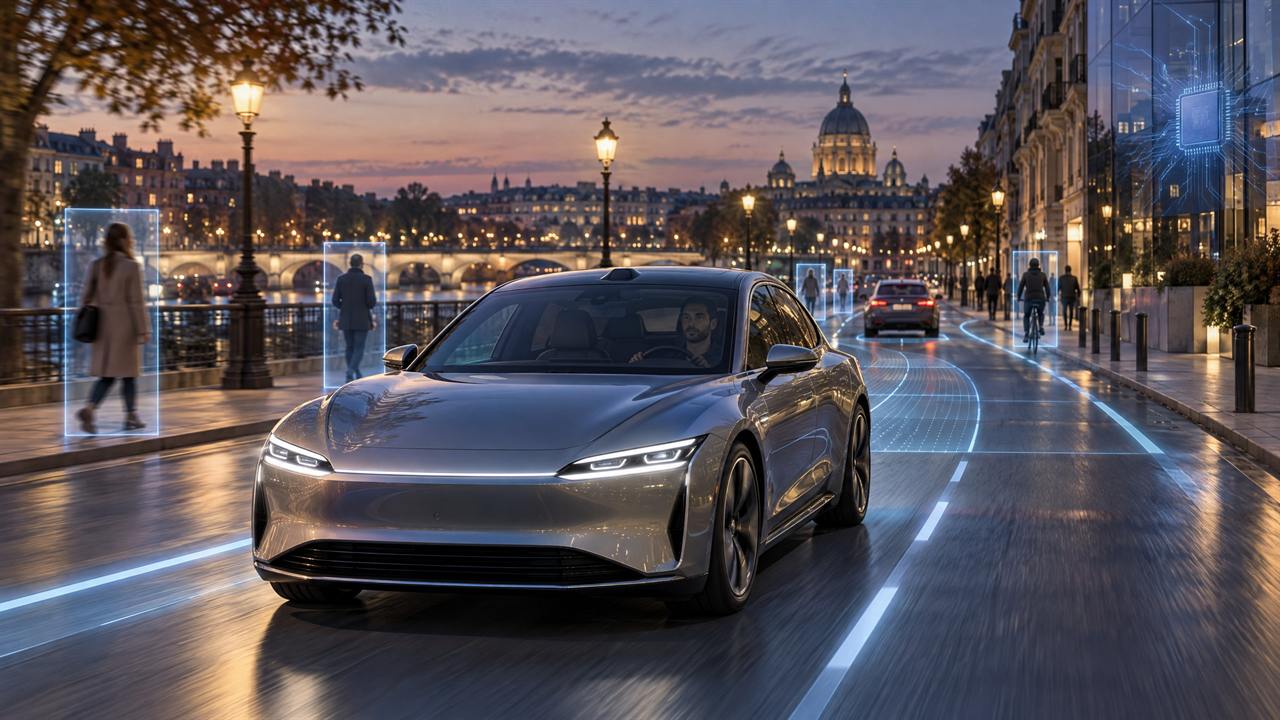
Mercedes-Benz and NVIDIA said on Oct. 16 that they will extend their partnership to develop the next generation of driver-assistance and automated-driving systems. The announcement expands a collaboration already used for urban point-to-point assistance, but does not name a production vehicle, market rollout date, or timetable for driverless service. [1] [2]
The proposed technology stack pairs Mercedes-Benz’s MB.OS vehicle operating system with NVIDIA Hyperion’s in-car computing and sensor architecture. NVIDIA’s Alpamayo Stack supplies driving software, while its Halos system adds a parallel safety layer that the companies say is intended to provide redundancy and guardrails. The partners also plan to use NVIDIA technologies in vehicle-engineering simulation and Mercedes-Benz’s MO360 digital-production system. [1] [2]
The stated near-term areas include point-to-point urban assistance, active safety and automated parking. The companies say the work will support development of future SAE Level 4 applications, including robotaxis or “robolimousines.” That is a development ambition, not confirmation that the new announcement delivers Level 4 capability to customers now. [1] [3]
A software-and-safety partnership
Automated driving depends on more than an onboard AI model: vehicles must combine sensors, compute, software, vehicle controls and safety measures. In this partnership, Mercedes-Benz contributes its vehicle engineering and MB.OS platform, while NVIDIA provides the Hyperion hardware-and-sensor architecture and driving software stack. The companies describe Halos as an added safety foundation, but the announcement provides no independent performance or safety-validation results for this expanded stack. [1] [2]
The announcement therefore signals deeper joint development rather than a consumer launch. Mercedes-Benz and NVIDIA have not specified which future models will receive the full expanded system or when customers could use the Level 4 applications under development. [1] [3]
Sources
- [1] NVIDIA: Mercedes-Benz and NVIDIA Expand Strategic Partnership
- [2] Mercedes-Benz: Mercedes-Benz and NVIDIA Expand Strategic Partnership
- [3] Tbreak: Mercedes-Benz and NVIDIA Extend Their Automated Driving Partnership Toward Level 4
Why It Matters
The inclusion of Halos as a parallel safety layer points to the central engineering problem in automated driving: redundancy has to be designed in, not added after performance testing. Extending the collaboration into simulation and digital production also suggests the companies see tooling and manufacturing as part of the same stack, not separate from the driving software. For now, the customer-facing effect is likely to arrive through assistance features, while the driverless applications remain a later development goal.