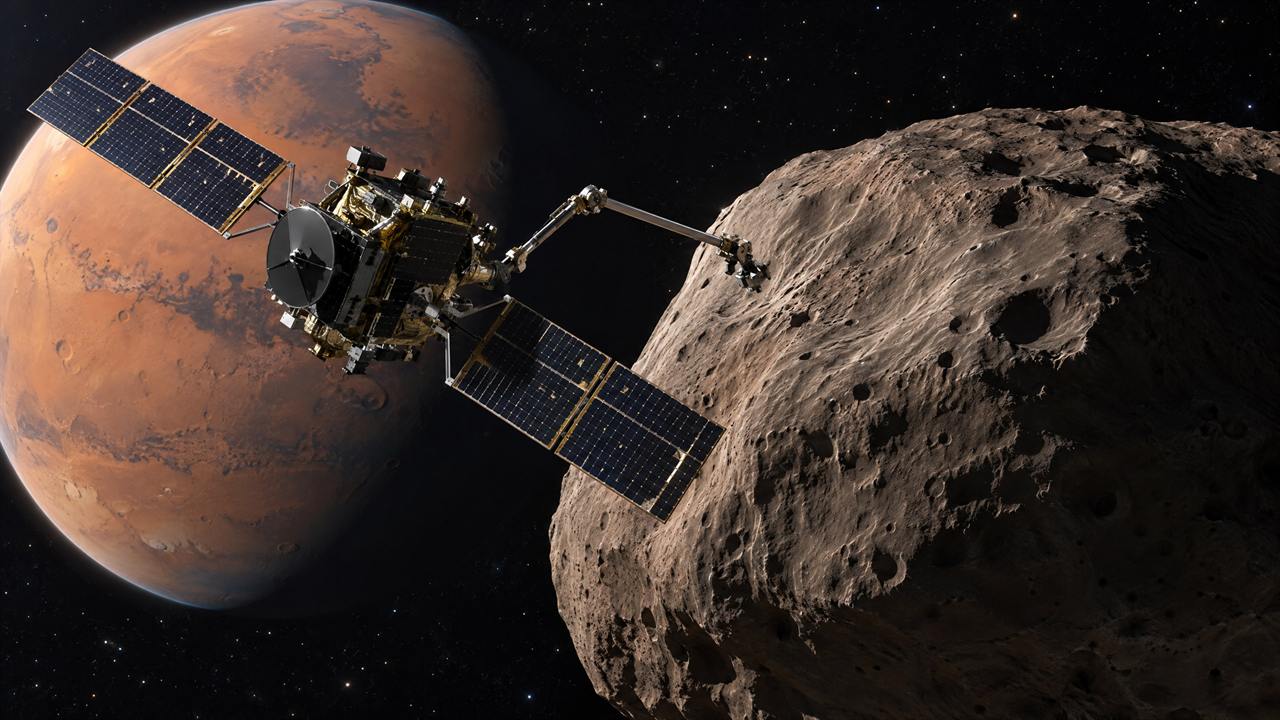
Japan’s Martian Moons eXploration (MMX) spacecraft lifted off from Tanegashima Space Center on Oct. 20 aboard H3 Launch Vehicle Flight No. 10, beginning its planned journey toward Mars’s moon Phobos. Reuters reported the launch, which starts Japan’s attempt to return samples from a Martian moon. [1] [2]
Phobos is the sample target
JAXA plans to survey both Phobos and Deimos, but the spacecraft is designed to collect material from Phobos. The mission will examine the moon’s surface, interior, composition and gravity, then attempt two soft landings. JAXA and the European Space Agency describe the sample goal as at least 10 grams. [3] [4]
The material could help scientists investigate the origin of Mars’s two small moons. One hypothesis is that they are captured asteroids; another is that they formed from debris after a large impact on Mars. The mission is designed to gather observations and samples that can help distinguish between these possibilities. [3] [4]
A five-year mission plan
NASA’s current overview expects MMX to reach the Mars system in August 2027 and begin studying the moons. The agency says sample collection is planned no earlier than December 2028, with the return capsule targeted to deliver material to Earth in 2031. These are mission milestones, not guaranteed dates. [3]
NASA is contributing the MEGANE gamma-ray and neutron spectrometer, a sampling technology demonstration, communications and navigation support through the Deep Space Network, and scientific participation. NASA also expects to curate about 15% of the returned sample at Johnson Space Center. [3]
JAXA had announced the Oct. 20 launch time and backup period two days earlier. With the launch now reported as completed, the mission moves from schedule to cruise and spacecraft operations. The next major milestone is arrival at Mars, followed by years of observations before the planned Phobos sampling and Earth return. [1] [2] [3]
Why It Matters
The origin of Mars’s moons is a question that returned material can help settle, because remote observations can support either the captured-asteroid or the impact-debris explanation without deciding between them. The mission also extends Japan’s sample-return work from asteroids to a planetary system, with NASA contributing an instrument and expecting to curate part of the sample. The payoff is staged and distant, resting on two soft landings, observations in the Mars system and a capsule return still years away.
Sources
[1] JAXA: MMX launch-time announcement [2] Reuters launch report via The Jerusalem Post [3] NASA: MMX mission overview [4] ESA: MMX factsheet